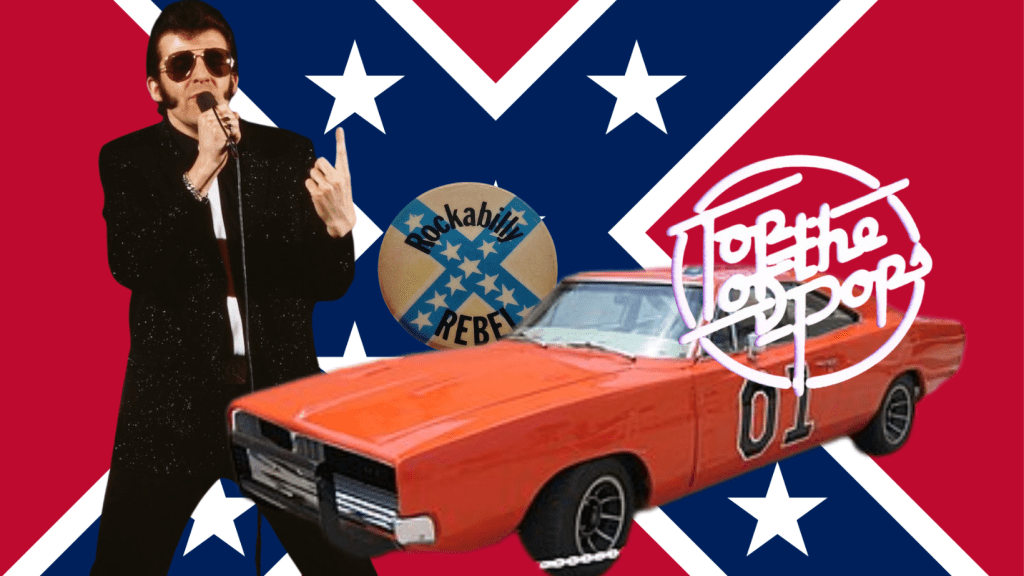
If you ask anyone at a Rock n Roll weekender their view of the ‘Rebel Flag’, they’ll have a strong opinion. For many, it’s a symbol of the Rock n Roll revival, a symbol linked with seeing Matchbox on TV or having fun in a specific social group, a display of their love of the rebellious lifestyle and their feelings about the southern origins of Rock n Roll. For others, the flag represents a past era which leads to a level of discomfort at best, and at worst disgust. The fact is, it’s always there, somewhere: on a t-shirt, on a band’s logo. Somewhere. In spite of the ban on flying the flag at many big weekenders back in 2019, usage persists. A petition was even started last year to reclaim the Confederate Flag as a Rockabilly Symbol.
For me, the rebel flag feels like a jarring anachronism. An accusation I get a lot is ‘you didn’t grow up in the scene’, and those people are right. I was born in 1987, the child of David Bowie fans, and I first got into Rock n Roll music in about 2003. I don’t ‘get’ the attachment to the flag.
This article isn’t about me though. It’s about you, and what you think. I wanted to know why people still flew it in 2026 and what people thought outside of muttered comments and Facebook posts in all caps.
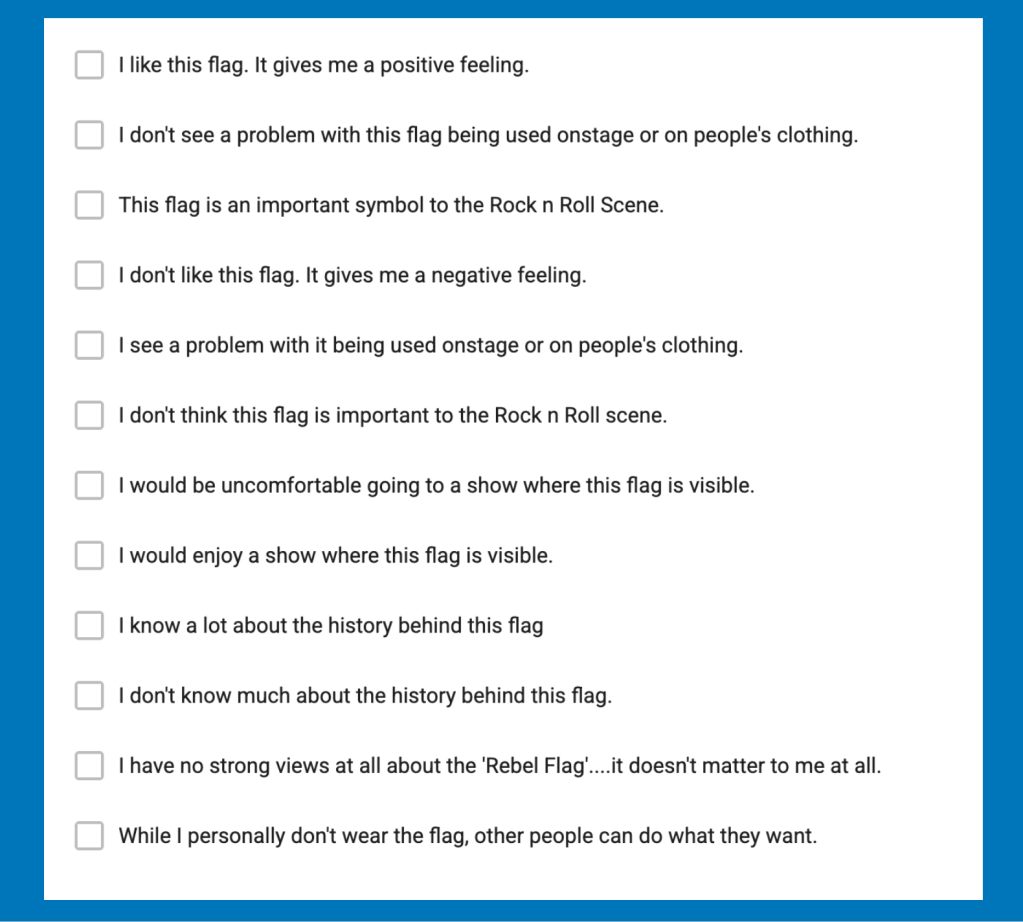
I decided to find out more about the use of the Confederate flag in Rock n Roll in 2026 via an anonymous survey. Obviously the survey isn’t perfect – I couldn’t exactly ask everyone who’d ever been to a weekender – but it did broadly reflect the make-up of the scene in terms of ages, genders and nationalities. I showed everyone an image of the flag, and asked them which of these statements represented their opinion. They could choose as many as they wanted.
Hundreds of people from all over the world responded: from the countries making up the UK, the USA, Germany, Canada, the Netherlands, Switzerland, Belgium, Finland, Australia, France, Spain, Austria and Portugal. Around three quarters were men, one quarter were women. Around half the people who answered put their age as between fifty one and sixty, and forty to seventy year-olds made up three quarters of the rock n rollers who answered.
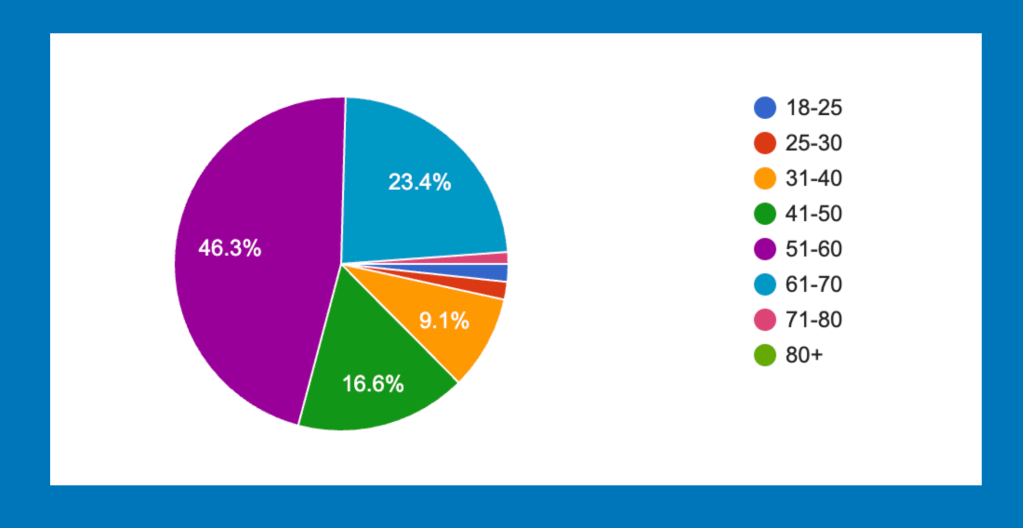
This made the answers more interesting. Broadly, we’d expect younger people who hadn’t been on the scene when the revival began to be less attached to the Rebel Flag and see it purely negatively, whereas people involved in the eighties might see positives that younger people hadn’t experienced. However, every age group and nationality gave a mix of opinions. There was no one group solely in favour or solely against, whether I looked at gender, nationality or age. One thing present across every group was frustration towards the opposing viewpoint.
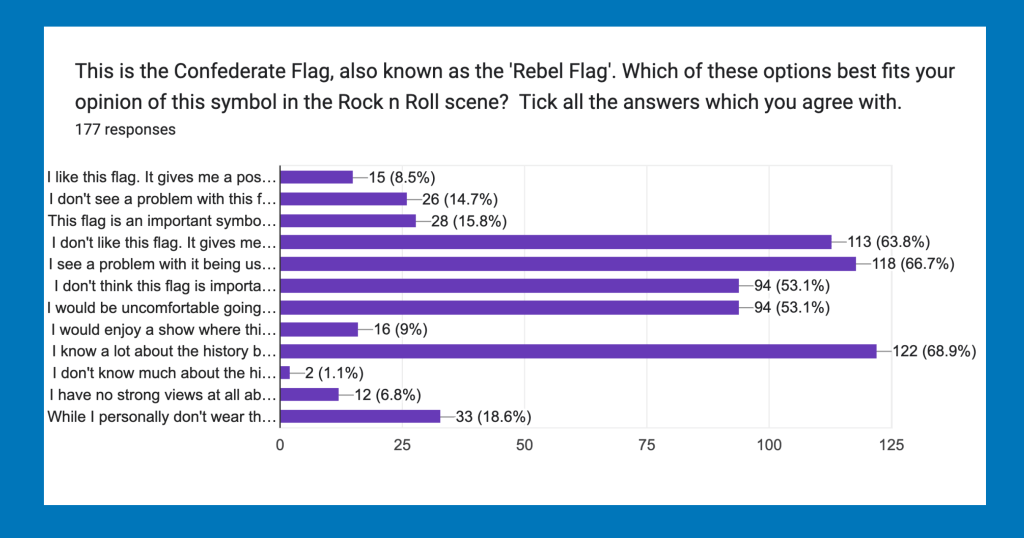
The results were very revealing. Less than 10% of people who answered liked seeing the Confederate Flag. Around 30% of people didn’t seem to care either way, if we add up all the answers which were neutral towards the flag. The majority of people actively disliked seeing the Confederate Flag at shows and chose the negative options. There’s not quite a direct correlation between the people who said they knew a lot about the flag (68%) and the people who disliked it, even though there’s a big overlap between the two groups: some of the people who felt they were informed about its origins chose the option of ‘while I wouldn’t wear it, others can do what they want’. Based on this sample, it seems very much like the scene in 2026 does not support the use of the flag at shows.
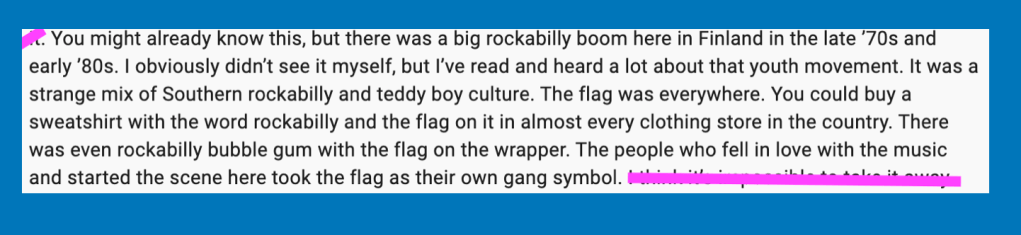
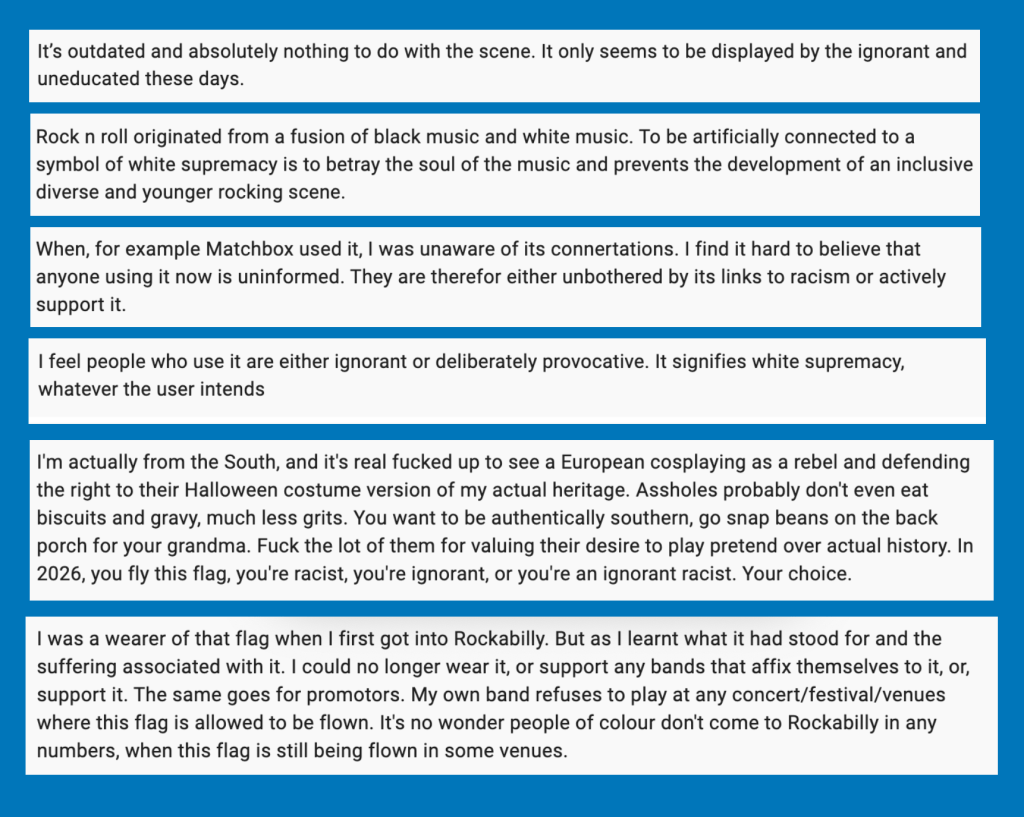
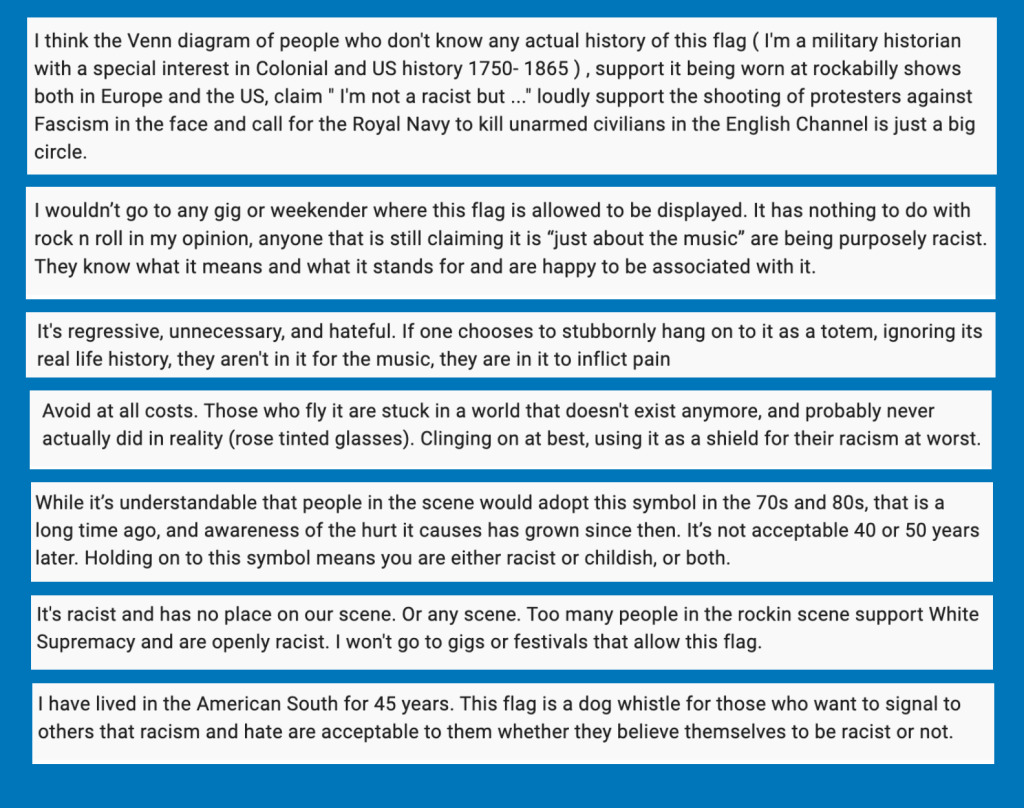
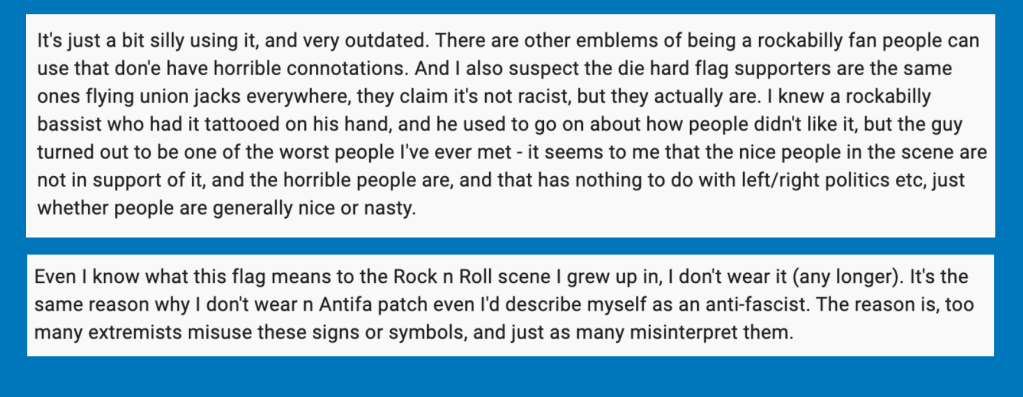
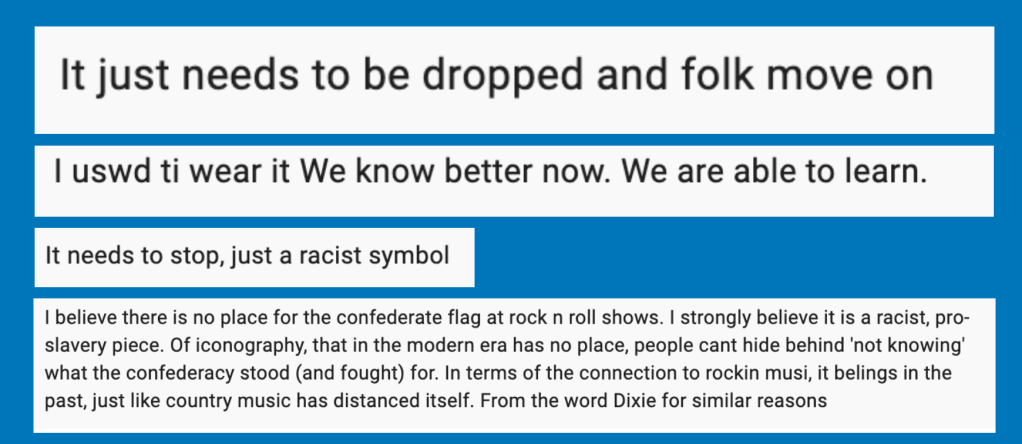
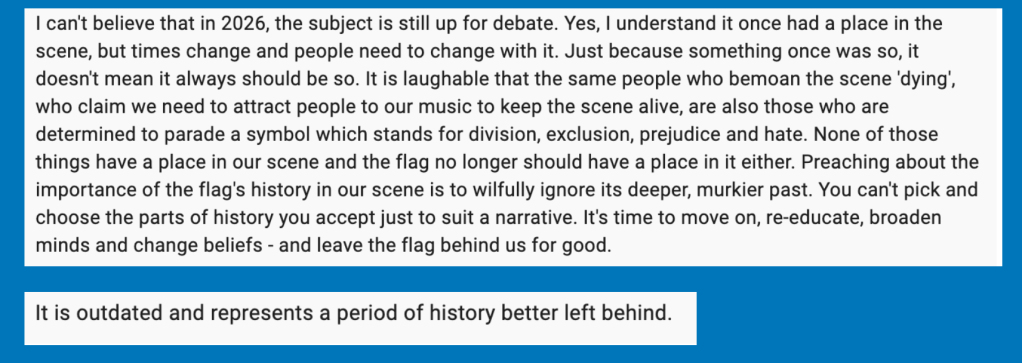
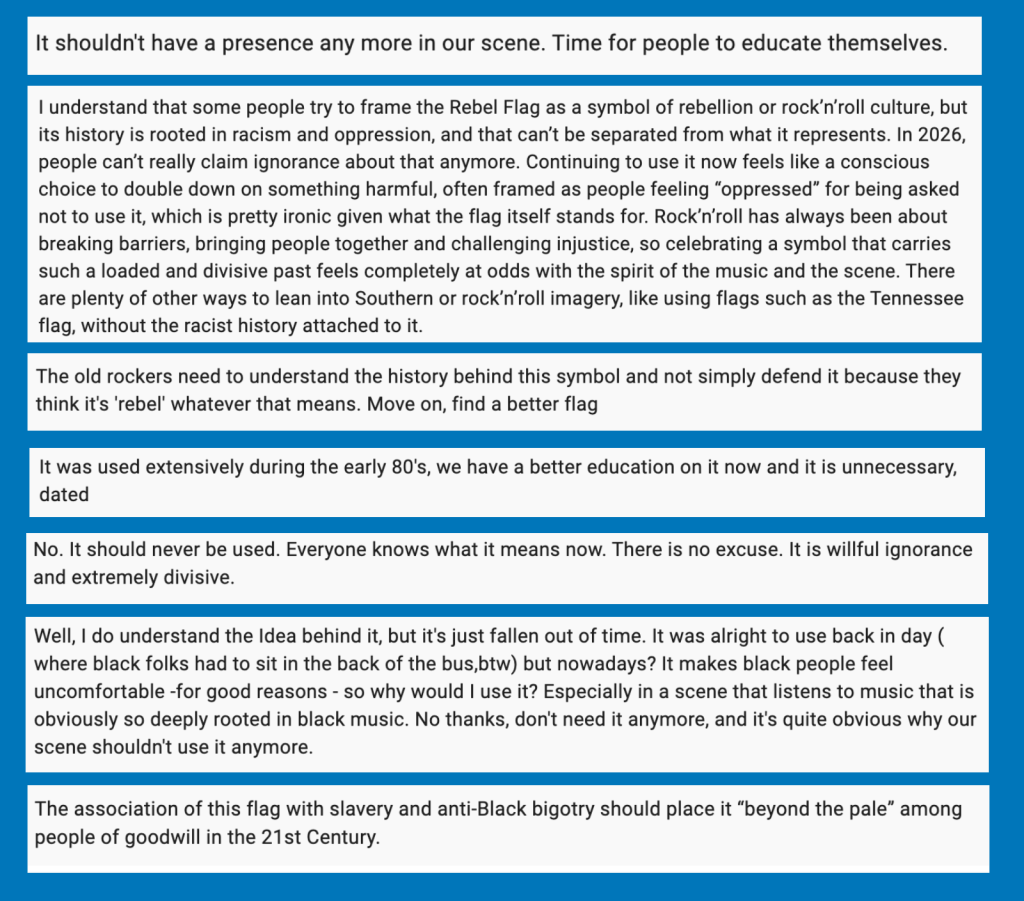
I asked people to give their full opinion, if they wanted to, about the continued use of the flag. Not everyone chose to give a longer reply. Some of the replies have been edited with boxes or lines for privacy or clarity. I’ve used screenshots so you can see exactly what people said without my interference. I haven’t included every comment as some answers were very similar, not easy to read or just an emoji, but I also haven’t cherry-picked the comments for bias. I’ve included almost every positive comment that wasn’t a single word or emoji. There just were’t very many of them.
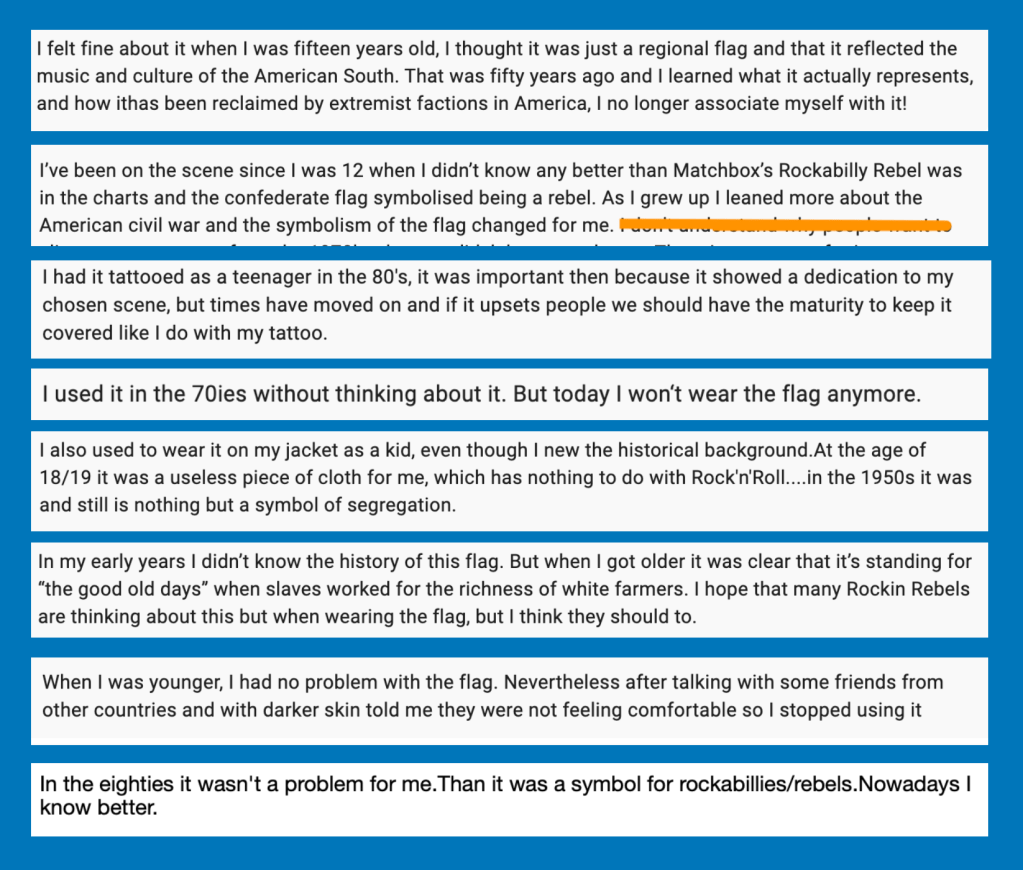
A lot of people talked about the 1970s, and the link between ‘being a rebel’, rockabilly and the flag.
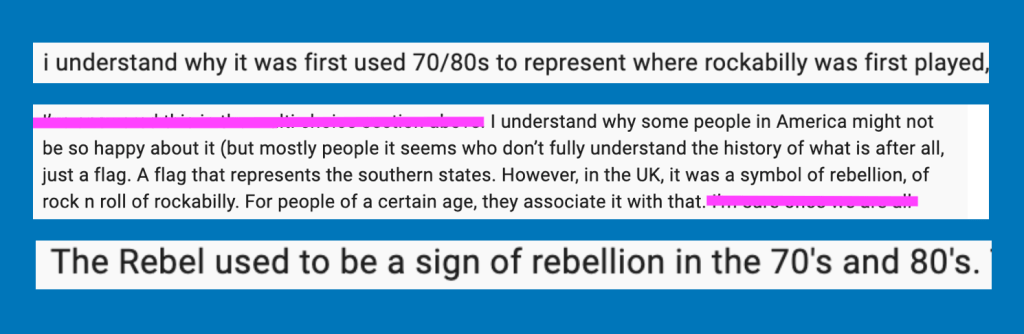
In 1979, Matchbox appeared in TV in the UK with the flag draped over their speakers and Graham Fenton in a grey confederate uniform. The Dukes of Hazzard had just premiered with their custom painted car. Lynyrd Skynyrd used the symbol extensively, though they later distanced themselves from it. Even Dave Lister has one on his jacket in the first season of Red Dwarf. It was part of pop culture in this era. As one commenter describes it:
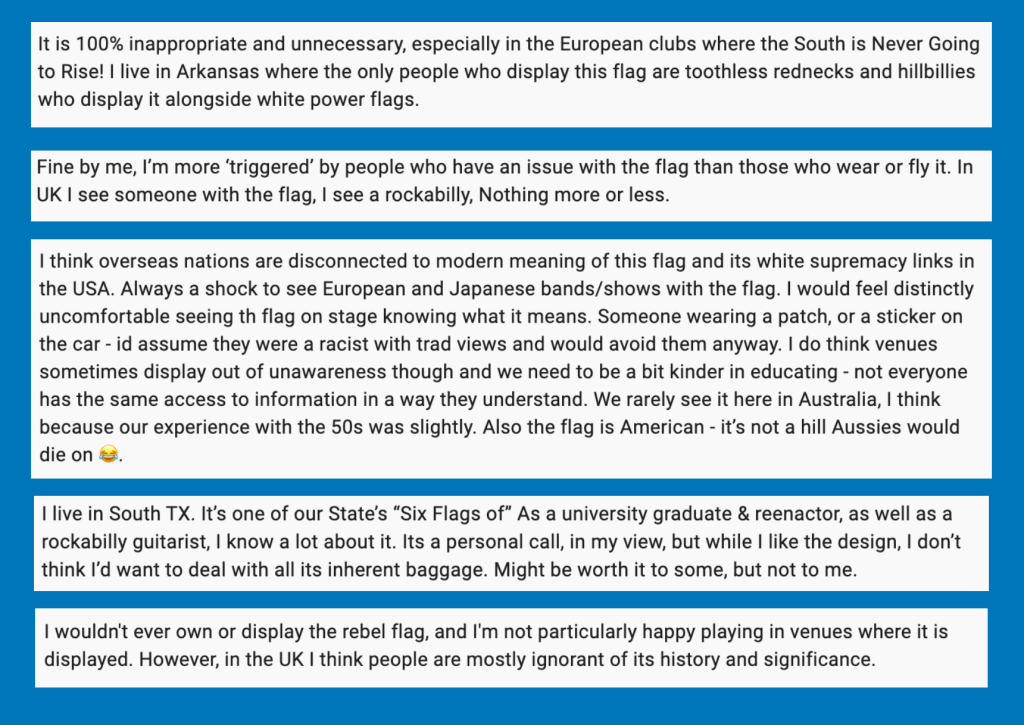
As you’d expect, the reactions to the confederate flag also varied by country.
The American Civil War Museum notes that‘the battle flag enjoyed (and suffered from) a short-lived, but intense, nationwide fad, and became a widely used popular culture symbol. Confederate heritage groups protested and southern politicians legislated in vain against “desecration” when the flag assumed new meanings as a trivialized symbol of rebellion, of rednecks, “good ol’ boys,” and southern rock music’. So, absolutely, during the 1970s this was a more-or-less acceptable symbol of being a rebel and with Rock n Roll’s southern heritage, for fans to use it then makes perfect sense. We can’t judge anyone for enjoying something we know to be bad when it was appropriate at the time: smoking was considered healthy until the fifties and corporal punishment in schools was legally acceptable until 1986, and we now know both of those are harmful. Different standards apply to different eras.
What changed a lot of people’s perceptions is that they learned about the history behind the Confederate Flag. While they may have enjoyed the patches and the imagery at the time, they now preferred not to be associated with a symbol recognised in the wider world as having extremely negative associations. Commenters were very honest about their own history with the Confederate flag.
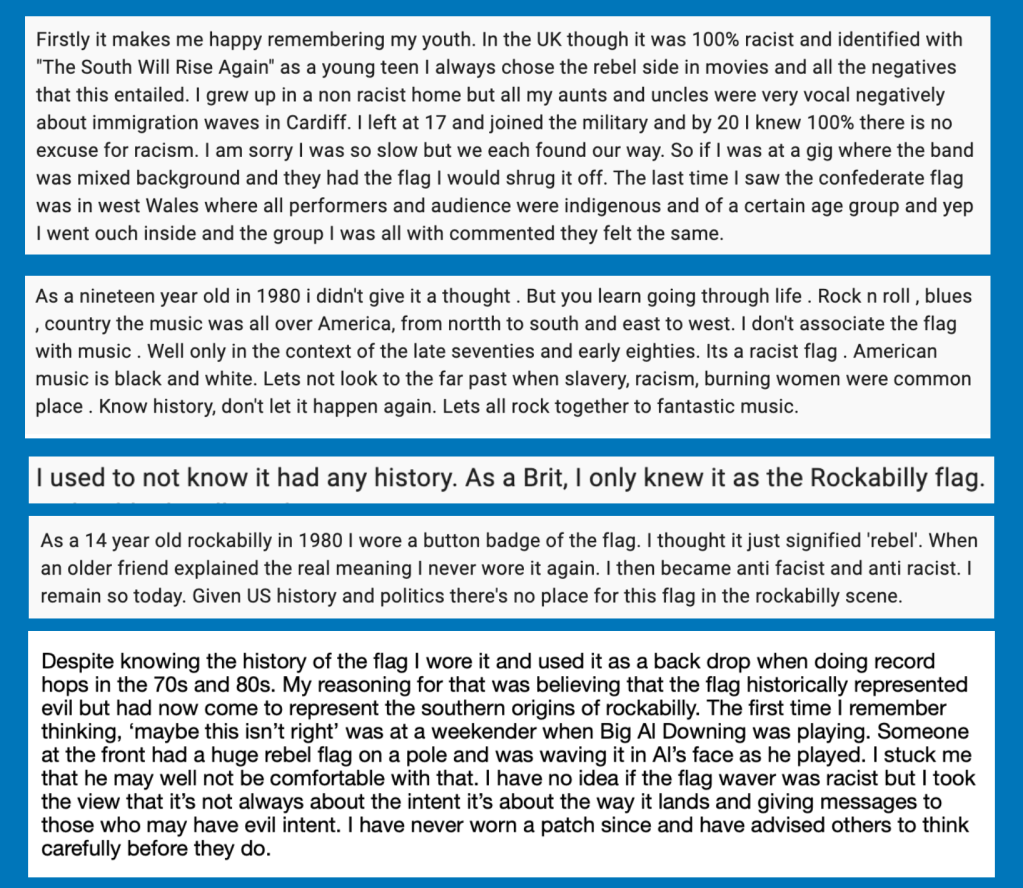
One person left a comment on my original Facebook post in which I asked people to take the survey, and they sum up the point of view which many hold: it was fine then, and it’s fine to look back on as representing a positive time in people’s lives, but not now.
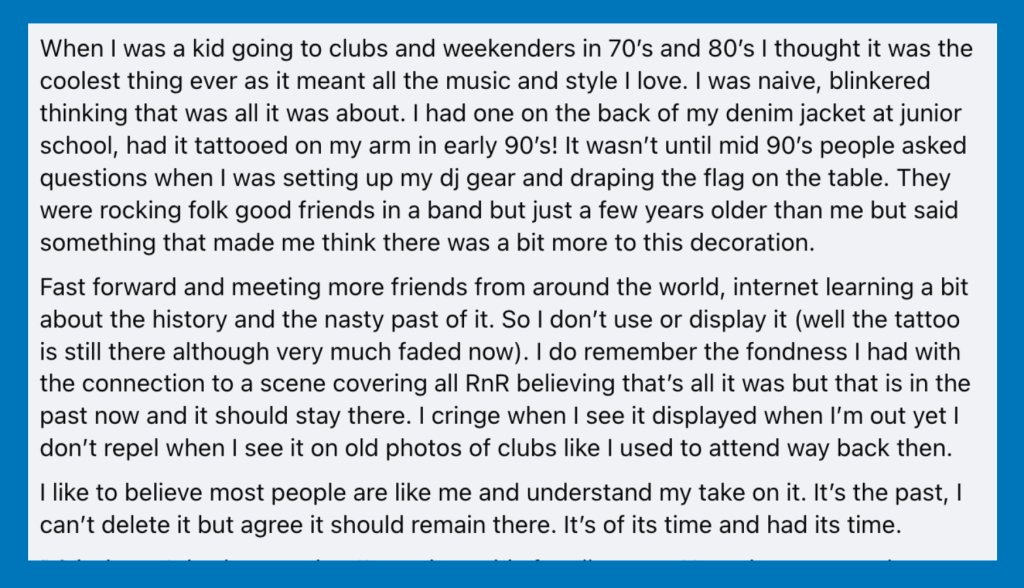
On the other hand, some people still feel attached to the symbol today, and disliked any idea of censorship. If you’ve been a rebel since your teens, holding fast to the symbol of your scene also makes sense if we think about personal history. I wear t-shirts from bands who split in the early 2000s because I still listen to their music and it reminds me of a specific time in my life…but I also know those t-shirts have very neutral logos on them.
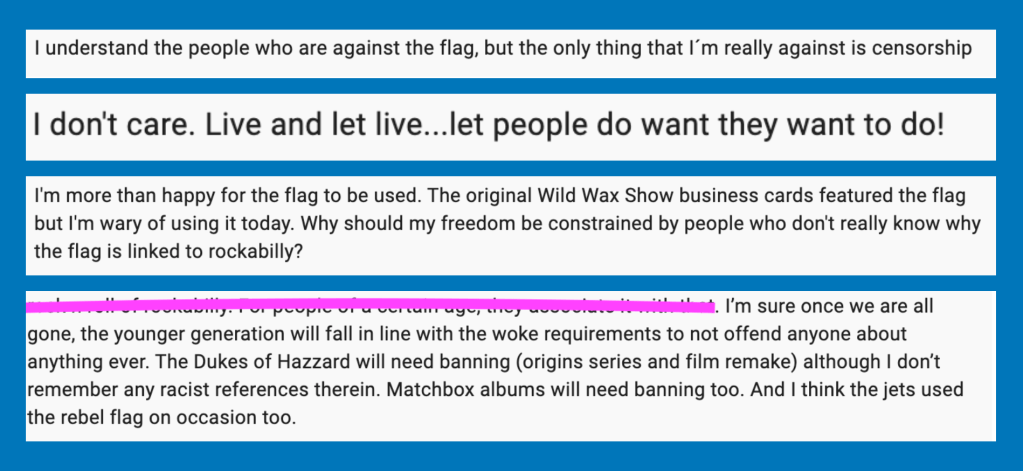
I’ll point out here that some Matchbox albums have already been reissued with different covers, and there’s no photos online of the Jets using a Confederate flag. The Dukes of Hazzard has been off the air since 2015, when it was removed from schedules after a racially motivated shooting in Charleston, South Carolina.

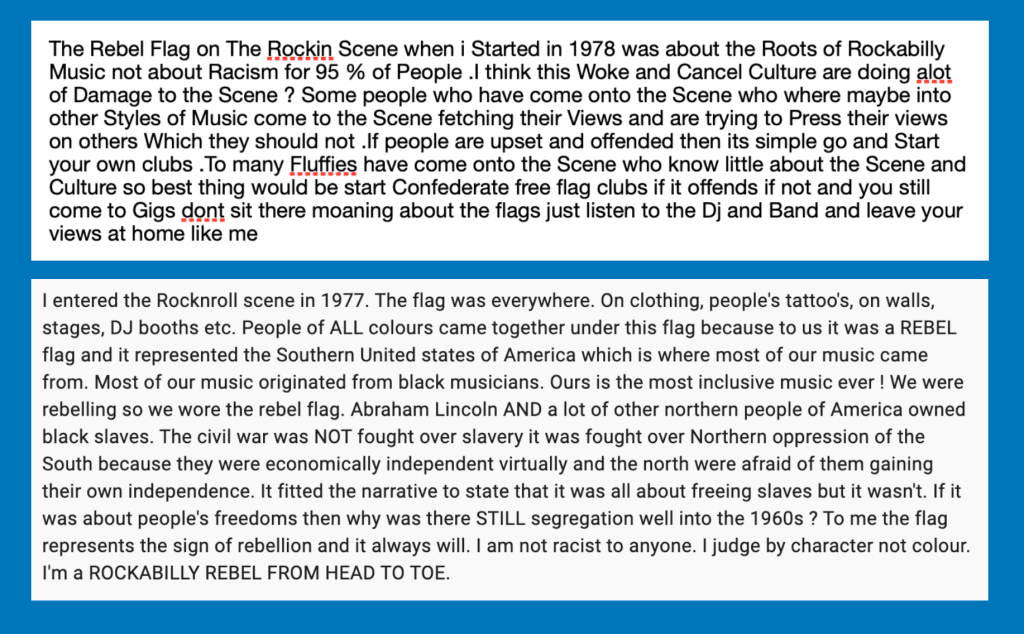
This is an interesting point. Historians of the American Civil War have altered their opinion after further study, and broadly agree in 2026 that slavery and the institutions around it were the biggest cause of the war. What historians believed in the 1970s wouldn’t be considered accurate now because they have more information available.

While this commenter is correct that Rock n Roll was a scene with fewer racial barriers in the Fifties, there were still many segregated concerts and if we think about the moral panic the music created, then it feels ironic that a flag with only a positive history for white people is used to represent the scene.
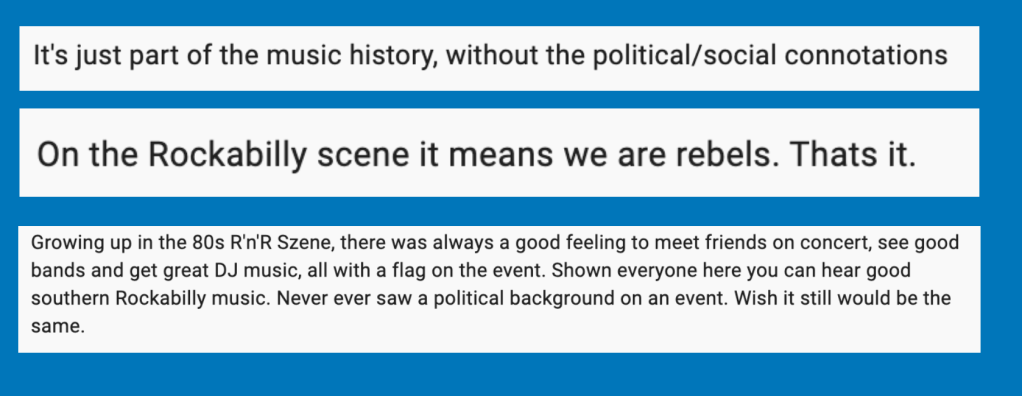
The people who were in favour, or neutral, about the flag, seemed to completely separate it from it’s origins. The issue comes from that separation no longer being possible in the wider world away from purely Rock n Roll spaces.

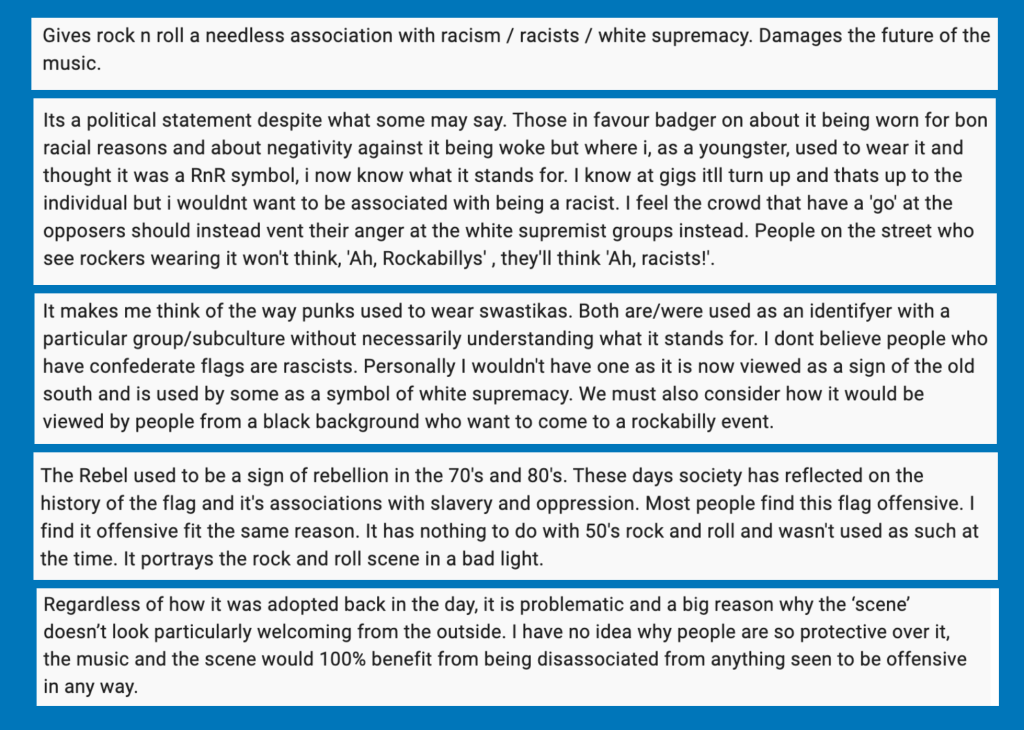
This comment needed highlighting. It felt like the writer was speaking as someone visiting a Rock n Roll show that had the flag displayed for the first time, and sharing an impression that we would hope to avoid. They’re also voicing a fear that lots of people expressed: folk who just wanted to dance and have a good time would be misjudged. I know that if I took a selfie at a show with the flag in the background, I would likely get comments asking if I was okay within minutes of posting it online.
The fact is, the ADL (Anti-Defamation League, the American advocacy group) has since designated the Confederate Flag as a hate symbol. Many were concerned about the damage the continued usage of the flag would do to today’s Rock n Roll scene and how we would be viewed.
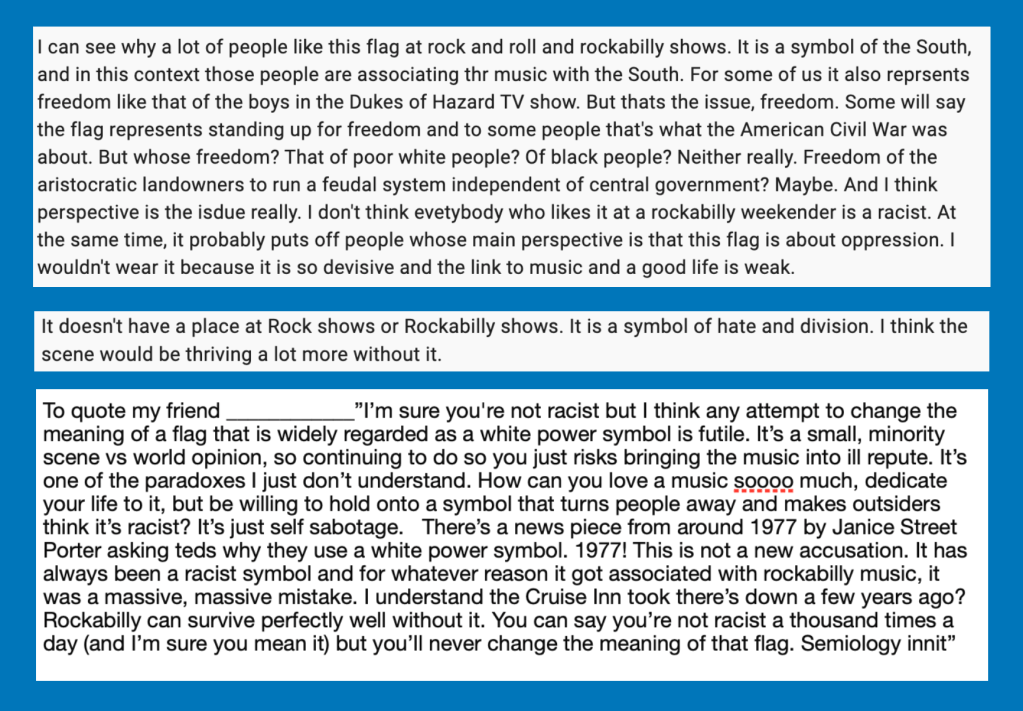
One person shared their personal experience too:

In fact, some felt that rockabillies who were emotionally attached to the flag were prejudiced or at least inconsiderate.
With an average of two music venues closing their doors permanently every week in the UK, and ticket sales falling for many smaller events, shows with smaller crowds will struggle to survive. On a purely practical level, a scene with a welcoming reputation, which goes out it’s way to make everyone feel included, will have an easier time in today’s world, regardless of how awesome the music is. A venue, club or band who are seen as unwelcoming will limit their audience and their potential.
The majority of comments reached the same conclusion: it’s time to move on for good.
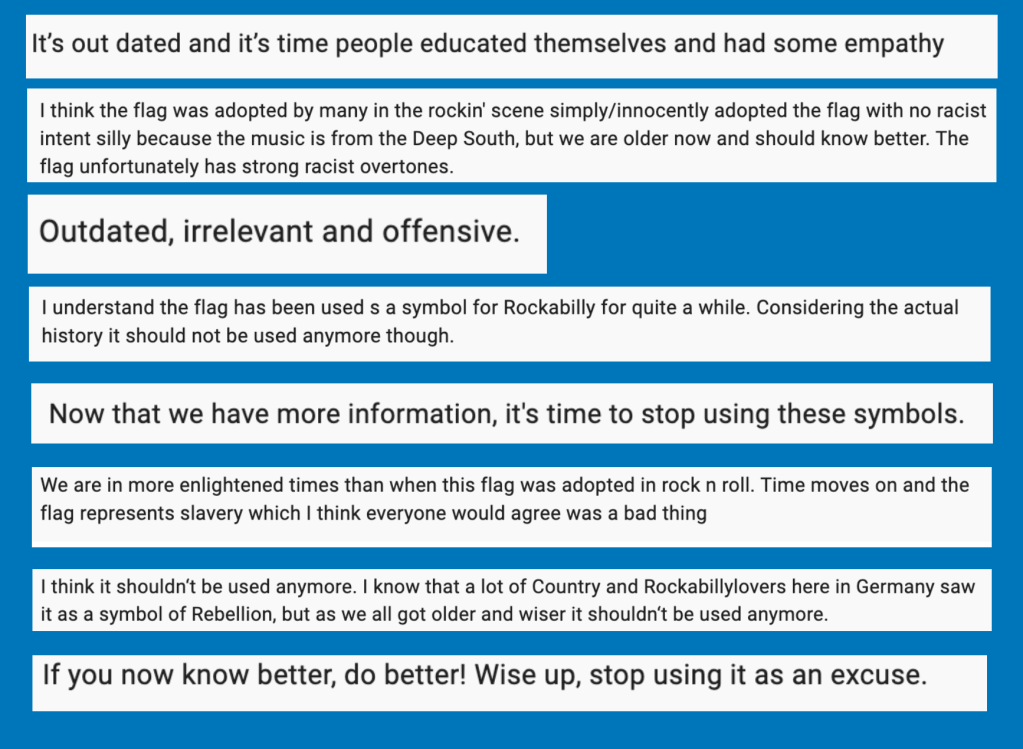
The Charleston shooting in 2015 was the moment when Country music, as a whole, decided to move on from using the Confederate flag.
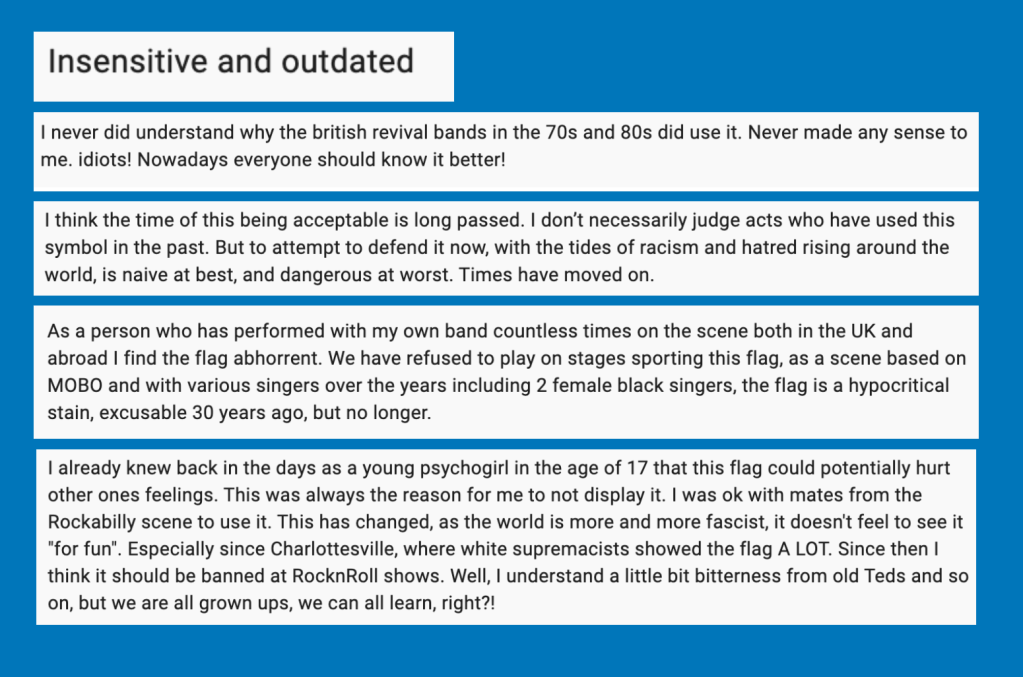
This commenter is talking about the 2017 white supremacist rally in Charlottesville, in which the marchers carried both Nazi flags and the Confederate Flag interchangeably.
In 1979, when Graham Fenton was on TV in his confederate uniform, people were hopeful that the newly elected Saddam Hussein would turn out to be a good guy. Symbols and views that were acceptable in the past might not be considered acceptable now, and vice versa. The Confederate flag’s meaning in popular culture has changed, whether we like it or not. If we look at other scenes or examples, it feels more obvious.
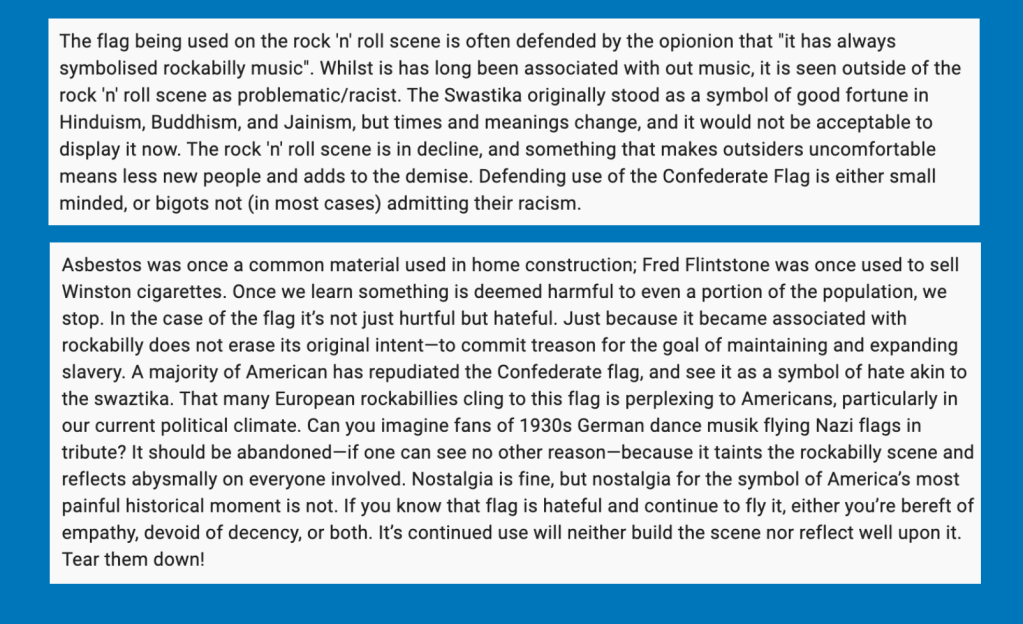
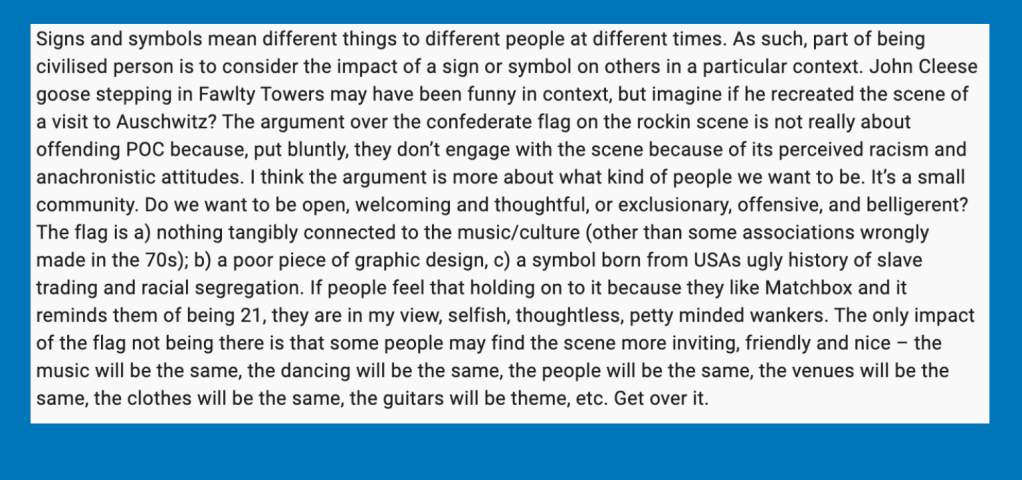
Whenever I’m faced with a difficult question, I turn to Rock n Roll music for the answer. Johnny Cash sang about the ‘Ragged Old Flag’ (which was a Stars and Stripes, a symbol for unity at a time of political turmoil) and was proud of his Southern heritage. He also practiced what one of his biographers called ‘the politics of empathy’ because he cared about the opinions of people less fortunate than him: Black people, Native Americans and the poor. Little Richard fought for everyone to feel included at his concerts, and Elvis donated money to the Civil Rights movement at the time when the KKK were flying the Confederate flag to intimidate the public. Sam Phillips, founder of Sun Records and a strong believer in following your own path, balanced his views on individual freedom with the inclusion of any talented musician he signed to his label. While none of the above were saints, they saw first-hand the divisions in society based on race and symbols and decided to try and do better.
What defines a member of the Rock n Roll community isn’t a flag. It’s a love for the music and the people around us. Whether it’s intended as a racist statement or not, it’s now seen by many in and out of the Rockin’ scene as a symbol of hate and discrimination because the meaning has changed in the public eye since it was first adopted. Over half the people asked didn’t even see the rebel flag as an important symbol any longer. Perhaps it’s time to focus on ourselves and our music rather than a symbol which polarises and carries more baggage than it was intended to.
As the Man In Black said, ‘all your life, you will be faced with a choice. You can choose love or hate… I choose love.’ It’s up to us which path we will follow.
Kate Allvey
 Rip It Up Magazine
Leave a comment