
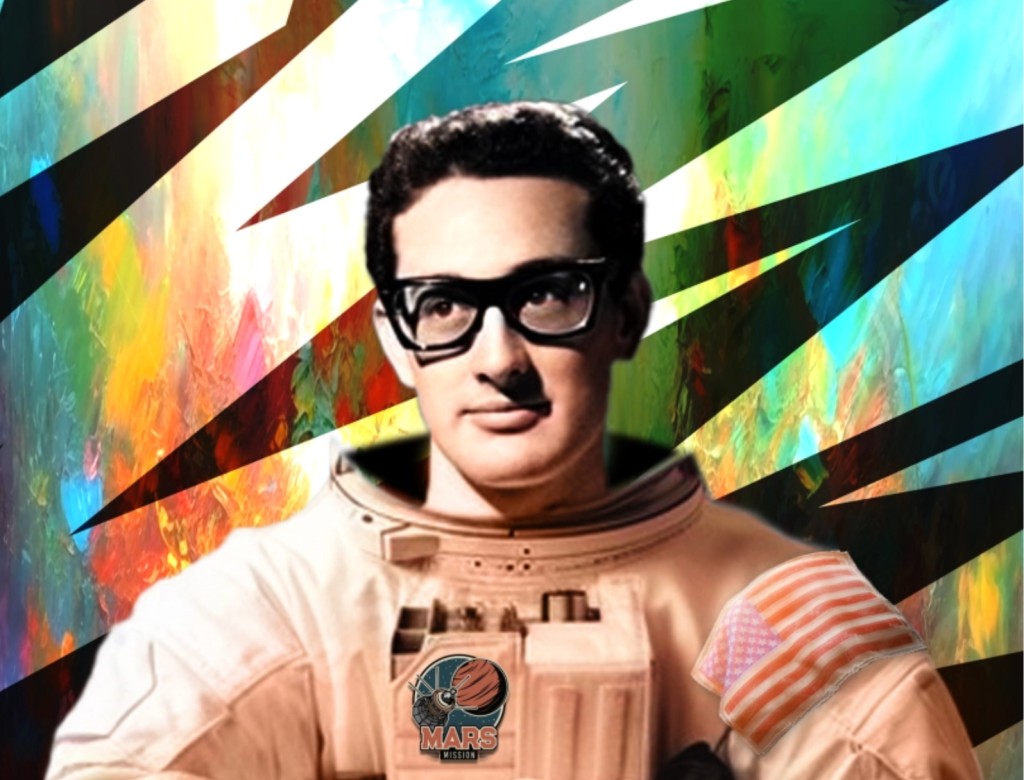
‘A Buddy Holly Story’ is a space western written in the style of fifties pulp. It straddles both sci-fi and fantasy and is inspired by real-life figures from the modern mythos.
Charlie Hardin is a Martian ranch hand and architect who seeks revenge for the mutilation of his horses and finds his true calling. He is also a clone of rock and roll legend Buddy Holly. What happens when the famous deny their raison d’être? When they resist fate, destiny, and the alignment of their stars?
Artwork by Chris Howard…
Instagram @_blondeman
The opening night of his new art show, Age of Aquarius, is at Creative Void in Wolverton, Milton Keynes on the 2nd October at 7pm.
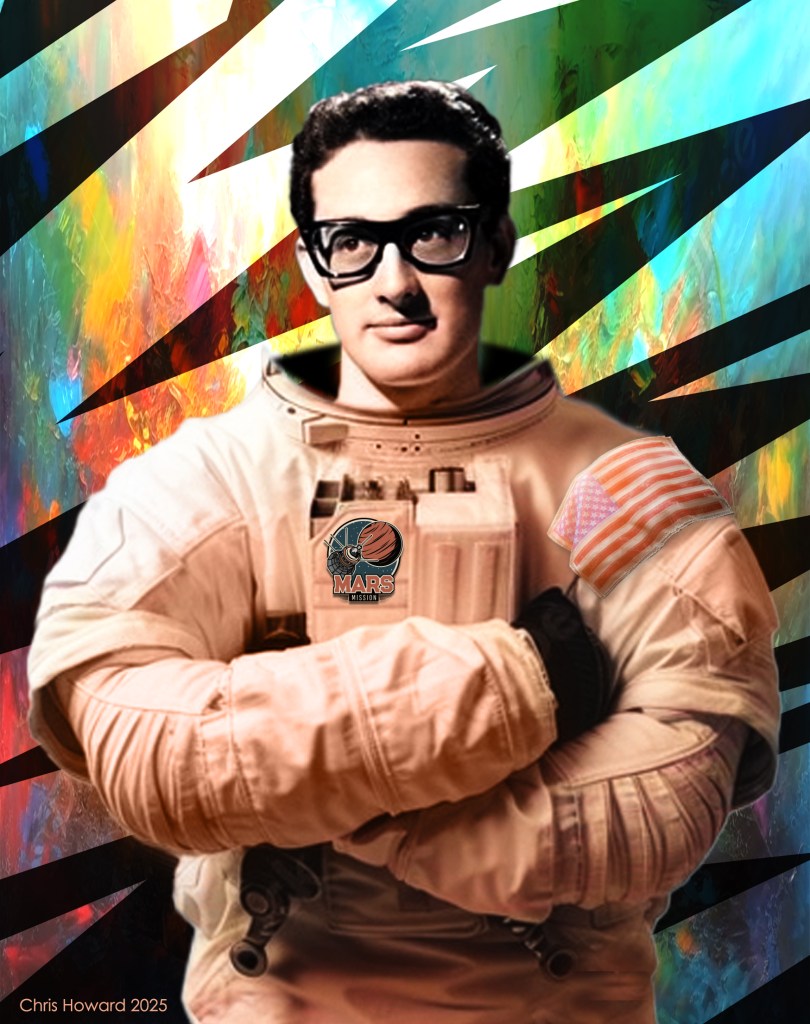
A Buddy Holly Story
by A. D. Stranik
Charlie could see big-wheeled buggies at the entrance of the estate as the Altamont cleared the edge of the crater. Banking portside, he dropped a thousand feet and spun the craft onto the landing pad. The churning red dust thrown up by the accelerator ducts obscured his leap from the cockpit and quick descent into the house from his unwanted spectators.
The house read him as he entered, and by the time he reached the workshop, it knew he wanted to talk to someone. It spoke in the timbre of warm female, ‘Recipient?’
Charlie scrutinised the monitor covering the entrance gates a kilometre away and could see at least three vehicles and a group of maybe ten people lining the perimeter fence, with cameras trained on the rusty landscape. They appeared benign . . . respectful. He relaxed.
The house enquired again. ‘Recipient?’
‘Sorry… Regulator’s office.’
A broad, perspiring face appeared on monitor 7. ‘Evenin’, Charlie.’
Charlie cut to it. ‘Bernie, I’m gonna need someone to come look at somethin’.’
‘What’s up?’
‘Someone’s messin’ with my horses.’
‘Rustlers?’
‘Well… best someone come take a look.’
‘Show me.’
‘Can’t. I’m at home now. Reception out there is all shot. There’s gonna be a storm.’
‘Those boys are expensive.’
‘Send ‘em.’
Bernie said okay, then his wet visage morphed into static.
The scene Charlie found at Cape Verde had been… bizarre. The heads of all seven of his horses had been removed and replaced with chrome-like spheres that seemed to be keeping the carcasses alive.
While he waited, Charlie, tall and wiry, approached the balustrade overlooking the painfully bright work deck—as big as a stadium—wide and deep. He designed places of worship now, a demand amplified by the opening arms of Southern India on Earth, where the epicentres of commerce had long ago shifted away from the west.
He’d been on this project from its inception four years ago—his biggest job yet—and now the multi-denominational temple was almost complete. There were concerns over the décor of the vestry and whether the lectern should feature a gargoyle/Vishnu hybrid as opposed to the usual eagle and whether the drive-in chapel should accommodate horse-drawn carts. As soon as these niggles had been ironed out, this full-dimensional CAD would be faxed to the presses that were waiting at a Ramanathapuram wilderness—mountainous machines loaded with prefabricated panels soon to be galvanised into steeples of veneration.
He climbed down onto the deck and, with a sweeping hand, bade the entire structure about-face so he could enter the back garden without having to walk the half mile to the front. He stooped, considering the distance between the orchid gates and the walnut benches. Finger signals shortened the distance by a metre—then another.
The house spoke. ‘Bus approaching. Memphis Flash N1935F requests landing clearance.’
Charlie regarded the difference and was unconvinced. He snapped his fingers, cancelling the change. His attention left India and was back here on Mars. ‘Okay, guide ‘em in.’
An immense black wasp of a craft joined the Altamont on the pad, scored with pink stripes, its skids tentatively feeling the hot red gravel before conceding to land. Charlie could see the regulators through the control deck windscreen, both in glare visors and chewing gum. Wild ones—all the guys who worked the Air-Rig were as untamed as this bloody landscape.
Three-year Air-Rig contracts—only the terminally rowdy need apply!
In the gate monitor, he noticed the crowd grow animated at the sight of this landing. All lenses turned towards the ‘Memphis Flash’ with its promise of more DNA of historical import.
He wasn’t sure if it was sympathy or a vindictive desire to dismantle their dreams when he’d occasionally humour his invaders with a tour around the grounds and perhaps sign autographs—usually on those large square envelopes containing the black glossy discs they used to engrave music onto. It amused him the way they scrutinised his long, gaunt face, hoping for a glimpse of the one they’d really come to see—a long-dead twenty-two-year-old singer with bad eyesight and caps. Instead, they found a balding fifty-year-old architect with geezer whiskers and zero interest in his genetic host.
Slender fingers brushed controls and turned off the monitor panel. He liked his hands—his fingerprints were his own.
Charlie dashed across the pad with his backpack and rifle and climbed aboard. The craft rose and sent him sprawling onto his belly.
From the cockpit, the taller of the two regulators shouted an over-the-shoulder greeting. ‘Mr Hardin, we’ll make Cape Verde in forty. The fridge is behind you. Grab yourself a beer and come on up.’
Charlie dropped himself in the cradle behind his hosts. Straps snaked across him and held him fast. ‘Can’t drink! Got an ulcer, but thanks!’
At the gates, hungry cameras devoured the ascent of the Memphis Flash as it roared across the estate and out into the red-grey desolation of the Meridiani Planum. The egg-shaped cockpit offered a stunning vista of the Martian plain spread out before them. The sun refracted off wan layers of new oxygen, already heavy with haematite. Kaleidoscopic patinas danced across the horizon until the Memphis Flash finally emerged above the freshly pumped atmosphere. The fields of Mars seduced Charlie—as they did everybody.
The craft settled into its course. The tall one drawled, deep Southern fried, ‘I’m Jiles; this here’s RV.’
RV offered a small dark hand, performing the dubious feat of shaking Charlie’s whilst ignoring it.
‘Bernie says you got rustlers.’
‘Well, kinda. You won’t have seen anything quite like this before.’
‘Pulmo-balls?’ RV said.
Charlie snorted. ‘S’cuse me?
‘Pulmo-balls. On the horses.’
‘Zat what they are? Kinda mirrored orbs. Some kinda static comin’ offa them. You seen that before?’
RV nodded to himself, a little too self-satisfied for Charlie’s taste. ‘E-queens did it.’
‘E-queens?’
‘E-queen counterfeiters. Equine. Geddit?’
Charlie realised he did know these men. Personally. Grew up with them. He was certain they remembered him too, but nobody said it. Thirty years? The elephant stayed in its corner. If memory served Charlie right, RV used to be a nice kid, happy, coltish. But now, it seemed, life at the Air-Rig had turned him into a little fat arrogant fuck. Charlie tried to fix little RV’s gaze but could only see his own wide, distorted face in his helmet’s visor. RV leaned over and flicked switches and sighed like all existence was too slow for him.
Jiles boomed again, in Charlie’s direction. ‘Didn’t you used to wear those big-ass glasses? Like binoculars they were!’
The elephant had come out of its corner.
‘Yeah. Not no more. I got zapped. ‘Twenty-twenty vision now, boy.’
Charlie expected this to ignite a big reunion chinwag about the good old bad old days of their being raised in the fruitless dorms of the Rock-Ola Music Academy.
But Jiles segued to the weather. The elephant vaporised. ‘There’s a fine old chance that this storm’s gonna meet us at the Cape. We don’t wanna still be there when it hits.’
Charlie noted it was actually forty-four minutes when the Memphis Flash performed its unsteady touchdown at Cape Verde—an inaccuracy of two hundred and forty seconds.
The men ambled down the craft’s service ramp and found the horses exactly how Charlie had left them. The heads had been removed and replaced with chrome orbs, about the size of bowling balls fizzing with static energy. Beyond this bizarre mutilation, they appeared alive and well. All seven of them stood in a row, still facing east, scraping hooves. All nodded with sage synchronicity in agreement with some absurd wind. One pissed heavily into the red dirt.
Jiles and RV removed their helmets. Charlie regarded the craggy features of his hired hands, chiselled by years of manual labour and whoring weekends. Yeah, he knew them…
The big man spat and wiped his chin with large knuckles, squatted, and punched a fist into the ground. He left it there, scrunched the dirt and appraised the distant mountains through squinting eyes and said, ‘Venusian smugglers…’
Charlie pressed his hand against the neck of the nearest animal. It was warm. ‘Whut they want ‘em for anyway, the heads?’
‘They got this mountain tribe on Venus who pay top dollar for ‘em. Use ‘em in some ritual, like a voodoo thing… Gotta be just the heads, removed in a particular way…’
‘But why leave the bodies alive?’
‘It’s for a voodoo ritual on Venus, Mr Hardin,’ RV answered quick. ‘You want logic?’ He marched back to the craft. ‘C’mon, scouts. Let’s go a scoutin’.’
For half an hour, the buggy trundled fast in an increasingly wide spiral outwards from the crime site.
Charlie shouted over the roar of churning rock. ‘You think they’re even still on the planet?’
Jiles shouted back, ‘Nothing breaks this atmosphere without registering. If they’re trying to take those heads off-planet, they’ll have to smuggle them via legit passage. For now, this thing’s local.’
The buggy hit the base of a crater, charged up, and skidded before the summit, throwing rocks far and wide. The three men leapt from the vehicle and climbed the last few feet to the top. The settling dust began to offer a revelation.
Charlie stepped forward as the view cleared. ‘Golly fuckin’ gee!’
Before them, a vast shantytown filled the base of the crater. The huts were an endless formation of transport brick-a-brac—panels of ship hulls on stilts of rusting steel. In the centre of the crater loomed a tower of red and lime green glass, trimmed with dulling, curving chrome.
RV reached inside the buggy and grabbed rifles, but Jiles said, ‘Fuck that. We’re driving in. That thing has got to be at least fifteen clicks away.’
The drive to the entrance of the tower was a thrill ride—if you like that kind of thing. Charlie didn’t. RV slalomed the buggy around the huts at speed, taking at least three of them down in the process. Recklessness was next to stupidness as far as Charlie was concerned.
The entire area was deserted, and now as they approached the immense chrome doors of the tower, they all recognised the structure—part church, part immense jukebox.
Relieved that RV’s big man display was over, Charlie grabbed his rifle and made for the entrance. ‘I’m gonna check that foyer.’
RV called after him, ‘You can use that thing, Mr Hardin?!’
Charlie ignored him and traversed the junk laden terrain.
RV handed Jiles a weapon. Simultaneously, they filled their chambers with fat gold cylinders and eyed the abandoned shanty town.
RV cocked his gun and aimed randomly at the nearest huts. He fired and flattened three of them. He gazed up in awe as debris rained down. He lowered the weapon, disappointed at the absence of surrendering vagrants, natives, hippies, or whatever—arms held high and jabbering whatever shit they called a language.
The huge neon sign above the doors to the foyer said ‘Rock-A-Rama’. The letters, flowing and stylised, traversed the entire width of the entrance and were caked heavily with dirt. Mindful of an avalanche, Charlie left the regulators to their vandalism and carefully shouldered a heavy glass door open and found himself walking on a plush carpet in the dark. He reached into his bag and tossed a Mag-Bomb. An eruption of light filled the room. A foyer of chest-high reception desks in red and green heralded what seemed to be a corridor stretching into forever—or the abyss—whichever was furthest. Charlie clipped another Mag-Bomb onto his rifle and fired it deep down into the corridor. Feeble light flickered; he guessed, around half a mile away, revealing mirrored walls decorated with electric guitars—thousands of them. The body of one was shaped like an old machine gun. Charlie blew the dust off the accompanying plaque. It read, ‘Peter Tosh 1983‘. Another was no more than a red oblong slab. The plaque read, ‘Bo Diddley 1955′.
He’d never considered the fate of the others who were to perform at the resort after Rock-O-Rama failed, and the thousands who’d emigrated here for glamorous careers at the “Entertainment Capital of the Galaxy”. He, like most of the others, was found to have no natural aptitude for music, and twenty years after being born and raised in music institutes and stage schools, it became clear that Rock-O-Rama was headed for rock ‘n’ roll heaven. The ‘talent’ were treated right, though. They finished ‘real’ school and got regular jobs as… stud farmers, architects, or Atmostation Air-Rig operatives who moonlit as regulators who, for the most part, outlived their genetic hosts. But the waitresses, sound engineers, busboys, caterers, receptionists, production managers, bar stewards, and sound techies… this is where they waited.
And waited…
All at once, the mirrors shimmered violently, and a blanket of dust slid from a thousand instruments. He heard the dull rumble of an explosion outside, then gunshots—old guns—un-networked, beyond account. Blindly, Charlie barged through the foyer doors outside and was immediately slammed to the ground. The dirt from the sign had cascaded down and half-buried him. He struggled free and heard a volley of shots from somewhere out in the town. The buggy was gone, and he knew the hired help was on safari. He vomited steely dirt and wished for that beer—ulcer or no ulcer.
Ominous silence marked his hunt. He hadn’t heard another shot for thirty minutes. His search through the town was a game of chance now, and he started to wonder if he could operate the controls of the Memphis Flash alone. The huts were crammed with crates emblazoned with the distinctive blue Vocare logo… medical supplies. Evidently, the area had been subject to a pandemic of some kind.
He reached a cul-de-sac—cut off by a high rusting wire fence. Beyond it was a cemetery so vast he wondered how the crater encompassed it. A prairie of death; ostentatious monuments enveloped in an endless sheet of red dust. Rock-O-Rama’s directors had had all the remains they could find exhumed from Earth and sent up here. His own genetic host was probably around somewhere. Would he shudder if he stepped over it?
The far distance blistered and warped the entire vista into swollen glare. He remembered the coming storm and realised he was unsure of his exact location. With RV’s crazy zigzagging to the centre, his bearings were all shot to hell. He pulled on his goggles. They adjusted themselves, and then, among the stones a hundred yards ahead, he saw them.
Jiles and RV stood together, leaning forward and gripping a headstone, each nodding east, their heads replaced with those featureless fizzing orbs. He tore at the fence; it crumbled in his gloved hands, and he entered the cemetery and brought his gun up to his eye, his sights traversing troubled terrain as he carefully approached the stricken duo. He removed a glove and placed his hand on RV’s as it gripped the stone. The hand was warm. He inspected where the orb joined RV’s neck. It was clean—not a trickle. Whatever they used to perform this was precise—immediate—surgical.
Bernie’s words echoed, ‘These boys are expensive…’
Searing heat in Charlie’s ear sent him clutching his head. He threw himself to the ground, and then he heard the crack of the shell as it ricocheted off a distant monument. Returning wits replaced his disorder. He’d been attacked.
He took up position behind the stone at the feet of RV and Jiles. Flanked by the nodding dead, his instinct drew his sights left—his weapon detected movement among a row of yacht-sized chrome capsules—a camp of Airstream caravans.
He retaliated with a volley of manual shots. The report of his missiles whipped up dirt in its wake and smashed a mess of communication dishes from the roof of the nearest caravan. Gravel rained down, a whispered roar, silence, and then commotion—human. Shouts—the language was foreign. Shots fired. Stone exploded all around him. The nodding dead were knocked back on top of him. Shells whistled over his head, churning up the ground.
Charlie rummaged through RV’s tunic pockets, found the key, and shouted into it. ‘Alarm!’
From the direction of the caravans, an ear-splitting siren cut through the cacophony of gunfire and shattering marble. The gang’s camp stood between him and the buggy.
Forget it.
Hot shells sheared the sole of his boot clean off. They were closing in. With his chin to the dirt, he looked furtive and quick for a clearing back to the fence. He found one—a cracked and dried-out conduit cutting between the tombs, and beyond it, a wrought iron fence of painted angels, flanking a marble edifice emblazoned with the words, ‘Rod Stewart’.
He rolled onto his back. The air blazed hot with his pursuers’ bullets. He pulled the cam-launcher from his chest and clipped it to the end of his gun and harpooned it at the gate. The camming device sprang-loaded on impact. He tugged, and it held fast. He tangled a leg in the straps of RV’s backpack and his other with Jiles’. The two were safely secured, but as he prepared to hit the switch to reel them over to the fence, the shooting stopped. This was no good. They’d hear the three of them as they were dragged fifty metres to the gate.
Charlie spilt his bag out on to the ground, grabbed a Mag-Light and tossed it—the cemetery was bathed in blinding light. A barrage of firing filled the air again. He slammed the catch. The three men were dragged fast across rough ground, through neglected meditation gardens and tumbleweed. They hit the gate hard, nearly taking it off its hinges. Charlie untangled himself from the others and lifted himself high enough to see the hot-spot they’d just vacated. He could see four puzzled men—squat, moustachioed, in matching leather ponchos—stabbing at undergrowth in murderous frustration and overturning corrugated panels with their long guns.
Charlie stabilised his rifle on a tombstone and set it to ‘cluster’. He eyed the sight and watched it lock on all four targets.
He tapped the trigger.
Four men dropped like puppets with their strings cut.
He stood over the smoking dead as they lay in the cemetery dirt. The devastation of the scene would be immortalised on databases somewhere merely as ‘shots fired’.
With the end of his rifle, he lifted the thick poncho of the one at his feet and saw two belts of bullets cross his chest. At their intersection, a wound of throbbing crimson illustrated the frightening power of his Pioneer 10. On a chain around the dead man’s neck was a small pistol.
Charlie stooped, yanked it off, and studied the object, cool and silver in his palm. Pearlescent grips—the barrel engraved with flowery designs rendered the object beautiful and stupid. He pocketed the piece and followed the trajectory of this dead man’s stare. The distant wall of the crater was crumbling.
Etiquette urged that Charlie bury these men.
The rupturing sky demanded that etiquette be fucked.
The buggy hit the ramp hard and bounced up into the guts of the Memphis Flash. Charlie vaulted out as the harness dropped from the ceiling and turned the vehicle around.
Jiles and RV were strapped in, so he left them slumped over each other in the back—their orb heads tapping and rolling around each other. The control deck was unfamiliar and dim. Through the cockpit window he could see the burgeoning rage of the Martian sky—epic—Wagnerian. An army of twisters, gigantic spinning tops, were ripping the landscape into a frenzy. He dropped himself into RV’s seat and hoped the craft would read him. Proxemics and kinesics be his saviours now…
The panel erupted into light; praise Jesus.
A terse Latino female voice requested his flight plan. ‘Where to, big boy?’
He flipped off his torn boots and yelled, ‘Immediate evacuation!’
Doors and hatches around the craft slammed shut. Immediate G-force slow-motion punched him into the hull as the Memphis Flash lurched up into the air and immediately hit turbulence. The craft wrestled as the edges of the hurricane gripped its black wings and sent it into a spin. Charlie stomped the manual bar at his feet and tried to tame the beast.
The cabin depressurised.
He vomited bile and dust.
The cockpit sucked in on him, and his fists screamed agony against the shattering windshield…
The night chopped into him like nothing he had ever imagined before. Even colder than last year, he guessed. Knee-deep, and still the snow came down.
Old man Juhl didn’t remember hearing the crash. In fact, he didn’t remember the walk down the hill from the house at all. But now he stood here among the scattered wreckage, of what minutes ago must have been a small plane—a Cessna, maybe?
Luggage was strewn around the wreck. Among them, bodies. Two, at least.
At first sight, he thought he was looking at old coats. His eyes adjusted to the dark, and he saw hands—bloodied white hands that glowed even in the snow—a tableau of tragedy.
One piece of debris glinted from the top of a crushed suitcase.
He stooped to pick it up.
A gun—nickel-plated. 22.
A Saturday night special.
He fired a round into the night air. The report was rendered a comedy pop, even in this silence.
He entered the house by the back porch, careful not to wake his wife, who, if she could sleep through tornadoes, could certainly sleep through a small and distant plane crash.
So unbearably cold, he shuddered as if wolves were trying to escape him. The fireplace smouldered, so he grabbed the phone from the porch-side table and took it over there. Control returned to his limbs, and then he dialled…
‘Sheriff, some fool gone crashed their plane in my field.’
It was gone 11am by the time the squad cars and ambulances left his farm, and he was ready to drop. From the kitchen window, he could see the wreck still piled high against the fence. Wires and fabric waved fitfully from its unrecognisable hulk. They told him someone would come back later and take it away.
He answered questions.
No—he hadn’t seen the crash.
No, he hadn’t heard it. Hell, he didn’t even remember the long walk across the field and down the hill—he just found himself standing among the wreckage. But he baulked, for some reason, at mentioning this.
His wife had risen by this time. He passed her on the way back to the bedroom. He didn’t mention the morning’s activity as she made her way to the stove. He assumed she wouldn’t even look out the window to see the diminishing commotion down the hill.
Singers, they told him.
A plane full of singers crashed in his field.
He buried himself under thick, warm blankets. Something dug into his side. It was the gun he found. He placed it under the bed.
He slept and dreamed… that he was married to a Puerto Rican girl and lived in New York.
Copyright A. D. Stranik 2007
First published in CERASUS Magazine: Issue # 9 Paperback – 15 May 2023
Buy a copy of A. D. Stranik’s latest book here
 Rip It Up Magazine
Leave a comment