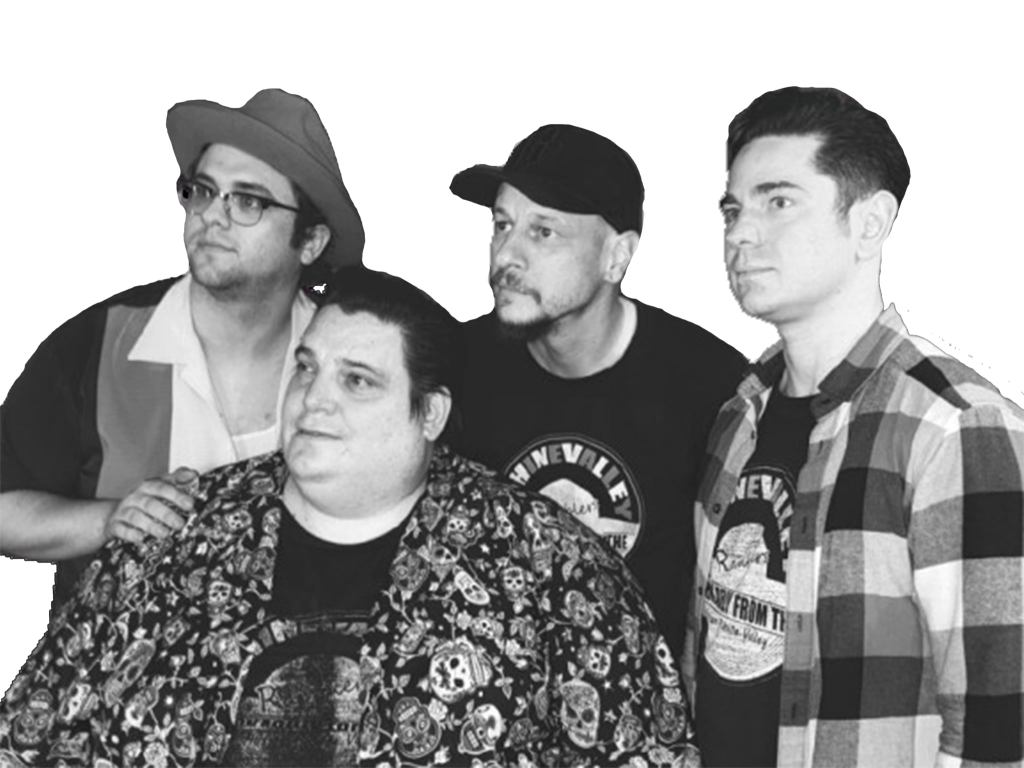
The Rhine Valley Ramblers are an original rockabilly band from Austria, fronted by Dieter Kräutl (Didi). Known for their raw energy, heartfelt songwriting, and modern melodic take on vintage sounds, the band has built a growing reputation across Europe. With members Fabio Schneider (bass), Gernot Tammegger (drums), and Bruno Serdarevic (lead guitar), the Ramblers are carving out a sound that’s authentic, honest, and full of spirit.

What follows is a Q&A interview with frontman Didi:
Who’s in [band] and what are your roles?
There’s Fabio Schneider on bass and backing vocals, Gernot Tammegger on drums, Bruno Serdarevic playing lead guitar, and me – Dieter Kräutl (Didi) – on rhythm guitar and vocals.
What’s your ‘origin story’?
Bruno and Gernot already knew how to play their instruments, but Fabio and I started learning ours when we formed the band. None of us had been in a band before.
It all started with me as a promoter. I brought the GoGetters to Austria, and Peter got me on stage with a pair of maracas. I was instantly hooked – I wanted to be on stage myself.
So I picked up a rhythm guitar, asked Fabio what instrument he’d want to play in a band, and found us a guitarist. Bruno first joined as a drummer because we couldn’t hold a rhythm to save our lives. That was the very beginning.
About two years ago, Bruno switched to lead guitar, replacing the original guitarist, and Gernot joined us on drums.
Which bands/artists are your biggest influences?
This isn’t an easy question because we try to do our own thing as much as possible.
But bands that definitely inspired us include Rhythm 55, Big Sandy, and some Wild Records acts like Eddie and thee Scorpions.
Do you adapt your sound between shows/countries?
Not unless we realize something isn’t working and needs adjustment. We play 99% original material.
What’s your favourite song to play live and why?
Right now it’s “Mad Man” for the audience reaction, or “Get Up” because I’m a sucker for ballads.
What’s been the highlight of your music career so far?
Definitely our new album that’s coming out in a few weeks. We worked really hard on it and are very proud of how far we’ve come. It shows our growth in quality, especially compared to the first album.
Have you faced any difficulties or setbacks? How did you overcome them?
Yes. First, when our original guitarist quit. It’s tough to find committed musicians in my area – especially those willing to tour.
Second, I have a medical condition that affects my legs.
How did I deal with it? Bruno stepped in on guitar, and I went to Gernot and asked him to join the band. Thank God that worked out.
For my legs – bar stools do the trick.
What’s coming up in the future for you?
We hope to play many festivals, and we’re constantly working on new songs. A new album is planned for next year.
Is there anything you’d like me to mention?
Yes – our upcoming album “Long Gone Baby”, which should be out in a few weeks. I’ll send you a copy to review.
TELL ME ABOUT:
Your last album – what was the process like?
We’re always working on new material. I write the songs and bring them to the band.
We recorded this album at Palac Crown Studios in Mäder, Austria. Marcel Bontempi designed the cover, and now that mixing and mastering are done, we’ll send the tracks to Walter at Plan 9 Trash Records for release.
Favourite song of yours?
On this album, it’s “Mad Man.”
Your craziest tour experience?
Definitely being denied entry to the UK.
We spent seven hours in a small room with a window into another room, where two officers just sat and stared at us.
Your sound – how would you describe it?
Honest, melodic, contemporary rockabilly.
Is there anyone you’d love to share a stage with, living or dead? Why?
Rhythm 55 – I love how they made cover songs their own. To me, one of the best bands ever.
Did you always know what kind of music you wanted to make?
Our sound developed gradually, but I always knew this was what I wanted to do.
Are your lyrics in character or based on your life?
Mostly based on life – not necessarily always mine, but they all have some truth in them.
Was there a moment or song that made you fall in love with rockabilly?
When I heard Elvis for the first time, I was hooked. First as a fan, then as a promoter – and now as an artist.
What’s the scene like in Austria? Do all the bands know each other?
Yes, we know each other quite well. I can’t speak for everyone, but I try to keep in touch with as many as I can.
The scene is shrinking – but we’re still here. 🙂
Are there many weekenders/all-dayers over there?
We have a great festival every November in Hohenems called “The Rockabilly Bombardment”.
I’m not sure what’s going on in eastern Austria – it’s a bit far to follow – but since we’re close to Switzerland and Germany, we have access to lots of festivals and concerts.
Tell us about your son’s band and playing with Eddie Clendenning and the Blue Ribbon Boys!
I introduced him to rockabilly, and it didn’t take much to win him over.
My wife and I are both incredibly proud of him.
What advice would you give to a band just starting out?
Don’t give up. There will be days and even weeks when you wonder how to keep going – but don’t give up.
In a band, your members become like family. You won’t always get along 100%, but it’s family. Stick together, and you’ll be just fine.

Tell us about your experience at border control, on your way to play gigs in the UK. Why did they refuse you entry, how were you treated, and what happened subsequently after? I know you managed to get a few gigs almost immediately — how did that happen?
Our biggest problem was the incredibly poorly organized and badly explained website of the UK government when it comes to visas.
We arrived in Calais on time for our train to the UK. Everything was fine until we reached UK border control. The officer at the checkpoint saw our equipment in the van and asked what it was for. I explained that we’re a band and had come to play a few gigs, with some holidays afterwards — altogether about two weeks.
We had a confirmation letter from our label verifying that we’re a signed and published band. We also had an invitation letter from you, Nick, and our visas were all in order.
Despite that, we were taken to a holding room where we spent around seven, maybe seven and a half, hours locked in. The officers conducted individual interviews, then made us sit and wait again. We weren’t allowed to smoke or leave the room in any way. While the conversations with the authorities were polite, the outcome was not.
We were refused entry because, as we learned, bands with day jobs require the venues to file a Certificate of Sponsorship with the UK Home Office. Without that, a band that isn’t fully professional (i.e., with other employment) isn’t allowed to perform — even if we wouldn’t have accepted any payment for the gigs.
We were fingerprinted and photographed, then handed over to the French police, who escorted us like criminals out of the tunnel area.
We lost our shows, all the money we’d prepaid for hotels and the Eurotunnel. You can imagine: we got ourselves completely drunk that day after being turned around like that.
Is there anything that bands from overseas should know about the process of coming to the UK to play a few gigs?
Quit your day job.
I say that half-jokingly, but also bitterly. I hope our misfortune helps others avoid the same fate. Make sure the venues know they need to file that Certificate of Sponsorship — otherwise, no matter how prepared you think you are, you won’t be allowed to play.
Nick Constantine
 Rip It Up Magazine
Leave a comment